The Dead Leave Evidence, Not Answers
“Oh, a house.”
That was my first thought when we pulled up.
Not disappointment. Not surprise, exactly. Just recognition.
It was a house.
It did not announce itself through size, architecture, landscaping, or any useful distinguishing feature. You could not tell someone to look for the place on the corner, the one with the red door, or the house behind the elaborate gate. You needed the address. Without the numbers attached to the front, it could have been almost anyone’s.
I had not expected a mansion. Nothing I knew about the man suggested that he had disappeared into a life of spectacular wealth. Still, somewhere beneath the practical reasons for the trip was a question I had never needed to answer before.
What kind of life had he built instead?
Was there a large house? A beautiful car? Expensive furniture? Some visible measure of comfort that might force me to wonder whether the life he withheld from his children had helped finance a better one somewhere else?
There was not.
There was a house.
I felt myself exhale.
Its ordinariness did not absolve him of anything. A modest home does not make abandonment less deliberate, and a cluttered living room does not convert neglect into hardship. But I would not have to stand inside a mansion and calculate what portion of it might have been purchased with our absence.
One harder question had answered itself before we reached the door.
Michelle unlocked it.
There was no ceremony. She had brought us there and had been inside before. She knew the key, the rooms, the rough geography of what had already been found. She did not pause at the threshold or warn us that we were about to enter the private world of the dead.
She opened the door.
The smell arrived first.
Stale air. Must. Dust settling onto older dust. The unmistakable smell of rooms that had been occupied for a long time and refreshed less often than they had been added to.
Old Man.
That was the category my mind supplied before it had gathered enough evidence to be fair.
Then the furniture made the smell visible. Heavy woods. Dark finishes. Chairs and tables arranged into small areas of repose, as though every few feet required another opportunity to sit down. Area rugs lay on top of carpet, with furniture placed on top of the rugs and objects placed on top of the furniture. The rooms were not hoarded. They still functioned. But movement had to be negotiated.
There was stuff everywhere. Art on the walls. Collections inside cabinets. Books and toys and knickknacks crowding shelves. Objects had been framed, arranged, elevated, and assigned places of importance.
The house felt heavy.
Some of that belonged to the furniture. Some belonged to the stale air. Some of it, almost certainly, had entered with me.
What I noticed almost as quickly as the abundance was what seemed to be missing.
There were very few family photographs.
The walls were not bare. This was not a house occupied by people indifferent to decoration. Art had been selected and hung. Collections had been arranged behind glass. Photographs of the two of them appeared here and there. But there were few of the casual signals that help a visitor understand the relationships inside a home before anyone explains them.
No broad scatter of children at different ages. No grandchildren. No pets I can remember. No family gathered around tables, leaning into one another on sofas, standing in yards, or squinting into sunlight at places everyone had agreed to visit.
A home does not need family photographs to contain love. A framed child is no more reliable as evidence than an unframed one. Still, houses communicate. This one communicated taste, accumulation, privacy, and possession before it communicated welcome.
On that first day we stayed mostly in the living room.
Several stacks of photo albums sat near one of the couches, and Fred began opening them. It was his first time inside the house too, or close enough that nothing seemed familiar. Michelle had more practical knowledge of the place, but none of us moved through it as memory.
Fred thumbed through albums while Michelle occasionally leaned in. They found old photographs of relatives and identified them for one another.
An aunt. A cousin. A grandparent. Someone connected to someone else in Argentina decades before any of us were standing in that room.
They would point to a face and explain the relationship. I listened. The information was accurate, presumably, but accuracy did not make the people meaningful to me.
They were relatives in the technical sense. Faces in another country, from another time, attached through a man I had never known. Their names could be placed correctly on a family tree without producing any sensation of family.
The albums offered lineage.
That was not the same thing as belonging.
We wandered more as the day continued.
At first, Fred and I generally asked before opening something. Not because Michelle seemed concerned. She was not. Her attitude was essentially carte blanche. Have at it. She pointed out things she had already noticed and joined us when something deserved a closer look.
The hesitation belonged to us.
It did not feel like trespassing against our father. Whatever claim he retained to the privacy of a desk drawer had become abstract. We were more conscious of Michelle. She had the key. She had the practical authority over the house and the responsibility of dealing with what it contained. I had known her for one day.
Asking before opening a cupboard was less about permission than courtesy.
Then she would wave us toward it, and we would open the cupboard.
Gradually, the house changed categories. It stopped being somewhere we had entered and became something we were allowed to examine. Drawers opened. Cabinets followed. We explored the office, the craft room, the shelves, and the objects that had been assigned enough value to be displayed but not enough explanation to be understood.
Death creates a strange form of access.
While someone is alive, opening a drawer in his bedroom is an invasion. Afterward, it becomes a task. Someone has to determine whether the envelope contains a legal document, a grocery receipt, an old letter, or nothing worth keeping.
The practical act quickly becomes interpretive.
Why was this saved?
Why was that framed?
Why was one thing placed behind glass while another was left inside a box?
Did an object survive because it mattered, or because no one had opened the drawer in thirty years?
The dead generally leave their possessions without labels.
The living supply the captions.
One collection hung on a wall: vintage railway pocket watches, possibly from Argentina, arranged with enough formality to suggest history and value. In the office, toys and small objects crowded the shelves around the desk. Robin’s craft room contained figurines produced and sold as collectibles, the kind once advertised with the promise that artificial scarcity might eventually become an investment.
There were Beanie Babies.
Time had answered that particular question.
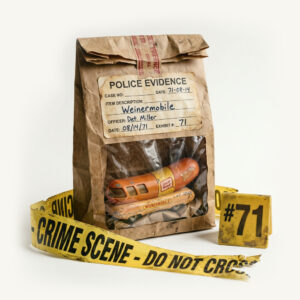
Then I found the whistles.
They were inside an Edwardian-style display table, the kind built with dark wooden legs surrounding panes of glass. The case looked ornate and old enough to be valuable. It suggested jewelry, rare coins, antique instruments, or some other collection proportionate to the furniture protecting it.
Inside were whistles.
Large whistles. Small whistles. Ugly whistles. Fat whistles. Common whistles. The collection contained the kind of variety that proves someone had stopped acquiring individual objects and begun acquiring the category itself.
My eye went immediately to several plastic Wienermobile whistles.
I remembered them from childhood.
Not those particular whistles, but the same kind. I could feel the smooth, rounded plastic against my lips. I could hear the high-pitched squeal. I remembered carrying one in my pocket, blowing it until every nearby adult had reconsidered the wisdom of promotional merchandise, and eventually discarding it into some toy bin where it disappeared.
Forgotten until another crossed my path.
The whistle was almost aggressively without value. It had been designed to advertise a hot dog shaped like a car. Like the hot dog it resembled, it sat briefly against the mouth, performed its task, and belched back a memory.
I knew what it meant to me.
I had no idea what it meant to him.
Perhaps he remembered the same thing. Perhaps someone had given him one. Perhaps he collected advertising novelties, or believed they would become valuable, or liked the absurdity of small objects that produced large noises. Perhaps the whistles belonged primarily to the case, filling the available space because every display cabinet eventually begins demanding contents.
The glass made them appear treasured.
That did not prove they were.
After someone dies, anything that survives begins to acquire false authority. A receipt looks like a clue. A greeting card becomes testimony. A plastic whistle preserved beneath glass begins behaving like a relic.
The object does not explain whether it was loved, forgotten, accumulated, or merely never discarded.
It only remains.
The whistles offered a possible point of connection between us. We might both have known the same smooth plastic, the same shrill note, the same ridiculous object in a pocket.
But a shared object is not a shared memory.
The whistle told me something about my childhood and almost nothing about his.
The photographs promised more.
There were boxes and boxes of them. Albums, folders, loose prints, and packets from the old developing shops where people once waited several days to discover whether anyone had blinked.
They had documented their lives extensively.
Travel. Business functions. Cruises. Landscapes. Buildings. Notable objects. The two of them standing in front of places they had gone to see, as though the photograph needed to prove both the destination and their presence within it.
Mostly, though, the photographs were of them.
Together or individually, they occupied the frame again and again.
The old family photographs were there, but they belonged largely to an earlier world. Ancestors, relatives, people in other countries whose names required explanation. The more recent archive felt narrower.
There were too many photographs for that narrowness to go unnoticed.
A sparse collection proves almost nothing. A few missing faces can be blamed on lost albums, bad cameras, or ordinary disorganization. But when a life has been photographed from nearly every angle, the repeated exclusions begin to feel less accidental.
The photographs did not prove that the house had lacked love. They did not establish loneliness, coldness, or deliberate isolation.
They proved what the camera had been pointed toward.
The camera kept returning to the same two people.
They had documented themselves thoroughly, and the more complete the record became, the smaller their world appeared.
Robin’s celebrity collection widened the frame without making it much more intimate.
Among the boxes were folders of photographs, letters, signed headshots, fan club responses, and material from studios or agents. There were pictures taken from a distance at public events, the celebrity visible but not necessarily aware of the person behind the camera.
On a wall outside the bedroom, the more prized items had been framed: playbills, autographs, letters, ticket stubs, photographs signed to her and occasionally to both of them.
Some of it represented genuine encounters. Most appeared to document proximity.
A letter had been sent.
A response had arrived.
A headshot had been signed.
A performance had been attended.
A famous person had once been near enough to photograph.
There was something familiar and human in it. Fandom does not require reciprocity. People have always reached toward performers, musicians, actors, and imagined worlds that make ordinary life feel larger. Today we give the impulse different names depending upon the franchise. K-pop. Superheroes. Vampires. Whatever currently flavors the culture.
Robin had been eighteen when their affair began. Barely out of high school. She had grown up in the beach cities of Los Angeles in the late 1960s, close enough to Hollywood that glamour must have seemed both impossible and geographically nearby.
I looked at the collection and saw a schoolgirl’s attraction to celebrity preserved well into adulthood.
That was my interpretation.
The objects could not confirm it.
Perhaps the letters and photographs represented uncomplicated joy. Perhaps she enjoyed the pursuit, the mail, the small thrill of receiving something signed. Perhaps the collection documented a lifelong interest no more psychologically revealing than someone else’s shelves of baseball memorabilia.
Or perhaps the artifacts helped her feel adjacent to a world she wanted desperately to enter.
The collection proved fascination.
It could not tell me whether fascination had fulfilled her or kept her waiting.
Some time after the trip, another artifact surfaced.
It was a small romantic photo book called Someday, the sort of thing that might have been sold in a stationery shop in the early 1970s. Every page contained amber light, beach sunsets, silhouetted lovers, and vague declarations broad enough to accommodate nearly any relationship.
It looked like a tampon advertisement.
On each page, my father had added his own words in hurried handwriting. The notes traced the beginning of the affair through fragments: the Music Center, the softness of her hand, walks on the beach, a first kiss, an embrace.
“The August of my life.”
“Courage was upon me!”
“Wow! It happened. It really did!”
The handwriting was fast and uncertain. Words had been scratched out or corrected. Punctuation accumulated as though emotion could be measured by the number of marks following a sentence.
On the final pages, he promised that someday she would be his and that he would treasure her as he treasured the moments already slipping into the past.
The book contained his handwriting, his dates, and something close to his voice.
It felt more authoritative than the whistles.
It still was not an answer.
The book established a chronology. It documented courtship. It showed how he chose to describe the beginning of the relationship to the young woman receiving it.
It also recorded a performance.
He placed himself inside a prefab romance of beaches, concerts, soft hands, and destiny. He wrote as a man presenting himself as cultured, poetic, and overcome by feeling.
I read it as an older man doing the heavy lifting of convincing an eighteen-year-old girl that he possessed culture and prose.
The book does not prove that interpretation.
It merely makes it difficult for me to read it any other way.
That is the danger of evidence. It narrows the possibilities without eliminating the observer.
The handwriting does not tell me what Robin knew about his marriages, what promises he made beyond the page, or how she understood the imbalance between them. It cannot establish whether she experienced the relationship as romance, rescue, seduction, rebellion, coercion, or some complicated mixture that changed as she did.
It cannot tell me what he thought about the children he already had.
It can tell me he wrote, “You will be mine.”
The distinction matters.
Uncertainty should not be used to dissolve fact. The dead cannot clarify their motives, but that does not require the living to pretend that nothing can be known. Dates remain dates. Ages remain ages. Words written in ink remain words someone chose to write.
Evidence does not answer every question.
It can still make certain denials impossible.
The longer we looked, the more the house seemed to offer pieces of a person without anything resembling a whole.
His workshop showed creativity, patience, unfinished ambition, and an attachment to making things by hand. His office revealed toys, computers, tools, and small objects arranged within reach. The similarities to my own rooms were difficult to ignore.
Fred, Michelle, and I found shared traits among ourselves too. Creativity. Technical curiosity. Entrepreneurship. The tendency to take objects apart, understand systems, and imagine better ways to make something work.
These were not the similarities I had expected to find because I had not expected anything.
They appeared gradually, in conversation and recognition.
I would notice a tool and understand why he had chosen it. One of us would describe a project and the others would recognize the impulse. The evidence was not only in the rooms.
It was standing inside them.
We were not merely examining what he had left behind.
We were part of it.
Four children had emerged from the same father, though not from the same version of him. Each of us had received a different measure of presence, distance, memory, and silence. One sibling could know a story another had never heard. One could possess memories where another had only dates.
Those differences did not make any account false.
They made the archive incomplete.
A person behaves differently across relationships. A father may be intermittent with one child, entirely absent from another, hopeful with a third, and estranged from a fourth. Each child can describe him accurately and still appear to be describing a different man.
The contradictions are not a flaw in the evidence.
They are part of what it proves.
The similarities offered their own kind of ache. They suggested conversations that might have been easy. Projects we might have built together. Interests that could have created an ordinary bridge between an adult and his children.
The evidence showed compatibility.
It could not explain the decision not to use it.
That may have been the sharpest thing the house revealed. Not that he and I were alike, but that we might have enjoyed one another.
There is no record for a relationship that never occurred.
No photograph of the project we did not build. No saved email containing the advice he never gave. No worn tool passed from his hand to mine. Absence leaves consequences, but it produces very little documentation of itself.
The missing relationship could be inferred from everything around it.
It could not be examined directly.
Still, I had not gone north looking for an explanation.
I went to see Fred again and to meet Michelle.
That was the value of the trip before we entered the house, and it remained the value afterward.
The dead man had created the circumstances, but the living people were the reason to cross the distance.
We approached the house without a theory. We were not detectives, historians, or forensic psychologists. We were three siblings moving through rooms, calling one another over whenever something seemed strange enough to require witnesses.
Come look at this.
What is that?
Why would anyone keep these?
Do you know who this is?
No.
We gathered evidence almost accidentally. A photograph here. A collection there. A resemblance. A shared instinct. A date that altered the shape of an old story.
None of it explained him.
The house told us what he owned, what they photographed, where they traveled, what they collected, what he tried to make, and how he once performed romance in hurried handwriting.
It did not tell us why he abandoned his children.
It did not tell us whether he regretted it.
It did not tell us what he believed would happen after enough years had passed.
The dead leave evidence because nearly every life creates residue.
Receipts. Photographs. Hair in a brush. Notes in margins. Tools worn smooth in particular places. Objects preserved beyond their obvious value. Children carrying familiar gestures without knowing where they began.
Answers require something else.
They require a person willing to speak while the question can still be asked.
By the time we entered the house, that possibility was gone.
Perhaps that was why the objects became so loud. Every whistle, album, letter, and unfinished project appeared to offer testimony because the only person who might have clarified it no longer could.
But objects do not testify.
They wait.
The living decide what they mean, what they prove, what they merely suggest, and what must remain unresolved.
We had gone there prepared to embrace the weird.
Mission accomplished.
The weird had been organized into albums, folders, cabinets, shelves, and ornate furniture. It had been framed on walls and tucked into drawers. It had been preserved in plastic whistles, celebrity headshots, romantic prose, and the bodies and minds of four adult children.
We found evidence of how he had lived.
We found evidence of choices he had made.
We found evidence of relationships that might have existed and the decisions that prevented them.
The house never produced an answer.
It did something more useful.
Somewhere among the heavy furniture, the stale air, the old photographs, and the hot dog whistles, Fred and Michelle stopped being evidence that our father had lived several separate lives.
They became my brother and sister.
We went there to examine what the dead had left.
The important discovery was who had arrived.

Ryan Villiers
Ryan Villiers is a Los Angeles-based writer and creative director whose work explores family, inheritance, memory, and the absurd ways people survive one another. He is currently seeking publication for his debut novel, The Field of Furze.