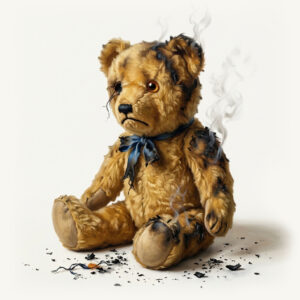
My Father's Other Children
Before I ever saw my father’s other children, I learned that he wanted them destroyed.
The request had been entrusted to a neighbor sometime before he died. It was simple, specific, and apparently important enough to repeat:
After I die, find the stuffed animals and cremate them.
Not his private correspondence. Not his browser history. Not financial records, photographs of old lovers, or documents suggesting a second identity in Argentina. Stuffed animals.
My sister told me about the request before we traveled to the Pacific Northwest to deal with the remains of his life. She had heard it from the neighbor, who had presumably received the instruction with the composure required when a dying man asks you to locate and incinerate a collection of toys.
I found the idea disturbing.
I also found it hilarious.
These responses did not cancel each other out. In my family, they frequently share transportation.
Why did the stuffed animals need to be cremated? Why did he care what happened to them after he was dead? Why not donate them, throw them away, or leave them to be discovered by whichever unlucky person eventually opened the wrong closet?
What were they hiding?
Money? Jewelry? A secret compartment containing some final explanation for everything?
I did not seriously believe any of those things, but cremation is a dramatic solution to a toy problem. Fire implies evidence. At the very least, it suggests a man who did not want someone looking too closely.
Then we found the photographs.
There were four stuffed animals: a lamb, a bear, a monkey, and a bird.
Always the same four.
They appeared on couches, in beds, beside Christmas decorations, on camping trips, and in the ordinary domestic settings through which real families document their lives. They were propped up, tucked in, grouped together, and carried from one occasion to another.
The photographs were not occasional.
There were lots of them.
Enough to establish continuity. Enough to show that these were not four toys arranged for a joke one afternoon. They had roles. They had relationships. They had a life being recorded.
There were also four biological children.
The lamb corresponded, in size and apparent gender, to my sister. The bear aligned with one brother. The monkey with another.
I was the bird.
No one had to call in a specialist.
The symbolism had arrived preassembled.
Psychology 101 had wandered into a toy store and returned with visual aids.
The animals were surrogates. Replacements. A family he could arrange, photograph, transport, and put away when the activity was finished.
Children without financial obligations.
Children without birthdays that had to be remembered.
Children who could not ask where he had been.
Children who did not require explanations, apologies, college tuition, emotional presence, or the ongoing administrative inconvenience of love.
They needed no commitment.
And yet, from the available evidence, they received one.
They went on vacation.
They celebrated Christmas.
They slept in bunk beds.
They sat together on the couch.
They were photographed with the dutiful regularity of parents who understood that childhood was passing and should be preserved.
The four actual children grew up elsewhere, in different houses and under different versions of his absence. The four stuffed children remained exactly where he placed them.
This was, in practical terms, a considerable advantage.
Real children develop opinions.
They remember things incorrectly, or worse, correctly.
They get older. They compare notes. They ask questions that begin with why and continue long after the available answers have become uncomfortable.
A stuffed lamb does not do this.
A stuffed bird can be taken on vacation without reopening an old argument.
A bear will sit for as many photographs as the photographer requires and will never once ask why his father had enough patience to pose him but not enough to call.
At first, I saw only the comedy.
The photographs were pathetic, theatrical, and deeply funny. Four plush animals arranged as a household, apparently maintaining a more active family calendar than the human beings they resembled.
I imagined them having private disputes.
The bear resenting the monkey’s side of the bunk bed.
The lamb insisting she had not agreed to camping.
The bird, obviously, making comments no one had requested.
But the photographs kept accumulating.
Comedy depends partly on distance. Quantity begins to close it.
One image could have been eccentricity. A collection of them suggested ritual. Eventually, the photographs began to feel less like an odd private joke and more like evidence of a sustained belief.
Then we found the Father’s Day card.
It had been hidden inside a design reference book that was buried on a bookshelf. Perhaps the book itself had been a gift. Perhaps the card had simply been placed there for safekeeping, though safekeeping and concealment sometimes share office space.
The envelope was addressed:
To Papa.
The card looked like something a young child might have selected in the 1980s. On the front, a large dinosaur and a small dinosaur prepared for a night of television, popcorn, candy, and soft-drink-based family intimacy.
“Something Special for Daddy on His Special Day,” it announced.
The large dinosaur held an enormous bowl of popcorn. The smaller dinosaur carried drinks and candy. They looked at each other with the goofy, uncomplicated joy available only to cartoon families and people selling them greeting cards.
Inside, the dinosaurs occupied a living room with a gaudy jungle-print couch, a side table and lamp, a brontosaurus figurine, several dinosaur-themed magazines, a remote control, and a large cathode-ray television. On the screen, a dinosaur wearing sunglasses drove a car, perhaps in the Jurassic version of Miami Vice.
The message read:
“Being with you, Daddy, is always a special treat! Happy Father’s Day with lots of love.”
There was also a coupon good for one whole night of watching a favorite television show and sharing hot buttered popcorn.
It was signed by the children.
Nanny.
Elmo.
Baby.
Johnny, also known as Juan.
The handwriting belonged to my father’s wife: the plain, familiar schoolroom cursive taught to a particular generation of American children before handwriting became a speculative elective.
The card changed the photographs.
The animals were not merely recurring props. They had names. They called him Papa. They offered Father’s Day gifts. They had been given a shared language and a domestic mythology.
More significantly, the mythology had not belonged to him alone.
His wife participated.
She wrote the card. She knew the names. She understood the roles. She helped maintain the fiction.
She also knew that his actual children existed.
That is the point where eccentricity becomes harder to enjoy without supervision.
Was it guilt?
Was it surrogate parenthood?
Was it an elaborate private joke sustained for years because neither participant knew how to stop?
Was it a way for two people without children together to create the performance of a family while avoiding the difficult human beings already attached to the husband?
Or was it something else entirely, something that made perfect emotional sense inside the walls of their home and only became pathological when exposed to daylight?
I do not know.
The dead are often generous with evidence and remarkably stingy with explanations.
Objects survive. Motives tend to leave early.
What I know is that these four animals were treated as a family. Not metaphorically, or not only metaphorically. They were named, dressed, posed, transported, celebrated, and eventually provided with end-of-life instructions.
Those instructions were followed.
There was a knock at the door.
My sister had just emptied the thirteenth open jar of stale nuts.
This is an important detail because nothing prepares a person to receive cremated surrogate siblings quite like discovering that two adults required thirteen simultaneous nut-storage options.
The neighbor stood outside with a vintage wicker flower basket hanging from her left elbow. In one hand she held an urn shaped like a black iron robin. In the other, she carried a medium-sized glass pickle jar filled with black soot.
“Hi,” she said. “I saw your car and thought I’d bring the kids and Robin back.”
My sister choked and chuckled at the same time.
It is a useful family reflex. The body attempts horror and laughter simultaneously, then leaves the throat to negotiate the jurisdiction.
“Oh,” she managed. “Come in.”
The neighbor entered carrying the household in its final form: the wife as a decorative bird, the children in recycled food storage.
She explained again how insistent my father had been about cremating the stuffed animals.
“He really didn’t want anybody to find them.”
My sister kept staring at the pickle jar.
The children had been found.
The children had been cremated.
The children had been returned.
The neighbor thought my sister might want to scatter everyone together.
My sister declined.
She explained that her brothers had visited and that they had already held a small ceremony. It had been, she said, very fitting.
This was true, although “ceremony” was doing some generous administrative work.
“You can take the ashes,” she told the neighbor. “Really. I’ll keep Robin and offer to send her to her nephew in California.”
Then my sister told her what I had noticed in the photographs.
There were four stuffed animals and four biological children. The sizes and apparent genders aligned. A lamb, a bear, a monkey, and a bird. The animals had been posed, dressed, transported, celebrated, and photographed in the ordinary situations through which parents build a record of family life.
They were us.
The neighbor squealed and nearly dropped the jar.
This was the correct response.
My sister gave her the abbreviated history: the four real children, the abandonment, the long distances between biology and fatherhood. Enough information to change the weight of the object in her hands.
The neighbor began to cry.
Her own father had died only a few weeks before my father entered hospice. She missed him terribly.
“I don’t know what I would have done without my father growing up,” she said.
There are sentences so innocent they become violent only after entering the wrong room.
My sister hugged her.
She comforted the grieving woman who stood in her father’s house holding the cremated remains of the toy children he had cared enough to provide for.
She also rolled her eyes.
She was not proud of this. The woman had done nothing wrong. She had lost a father she loved and was trying to imagine childhood without him.
My sister did not have to imagine it.
Still, she held her. This is another family reflex: caring for the person whose grief has accidentally insulted yours.
The neighbor agreed to take the children back.
My sister told her to take the wicker basket too. That was where they had lived.
Before the neighbor left, my sister offered her a nativity set that held some meaning for her. The neighbor accepted it. They exchanged thank-yous and see-you-laters, and then she walked away carrying a small religious family and a pickle jar containing the remains of another one.
The stuffed animals had acquired a new name by then.
The Ashkids.
Their father was dead. His wife was dead. The children had been burned according to his wishes, delivered to his biological daughter, declined, and returned to the neighbor in the basket that had once been their home.
Even after cremation, they had better continuity of care than we did.
I still wonder what the neighbor thought when she originally received the request.
A dying man had asked her to enter his home, locate four specific stuffed animals, and make certain no one else ever saw them. Perhaps he offered an explanation. Perhaps she decided, correctly, that there are moments when neighborliness requires a person not to ask follow-up questions.
She kept her promise.
There is something touching about that, which is irritating.
There is also something sad about the fact that I never saw the animals themselves.
I would have liked to inspect them.
Not out of sentiment. Not entirely.
The photographs showed our bestuffed counterparts from a distance. I wanted to see the worn fabric, the repairs, the flattened places where they had been held. I wanted to know whether their bodies contained anything beyond stuffing or whether the secret was simply that they existed.
Most likely, the animals themselves were the evidence he wanted destroyed.
Perhaps my father understood, at the end, what they would look like to the people he had left behind. Perhaps he feared the parallels would be obvious. Perhaps he knew that four toys, arranged as children and given the rituals of children, might function as an accusation once the actual children entered the room.
Or perhaps he simply loved them.
That possibility may be the strangest one.
He may have loved them sincerely, in whatever way a person loves an object onto which he has projected enough life. He may have felt tenderness toward them. Responsibility. Loyalty. He may have believed they had shared experiences worth protecting.
People are capable of genuine emotion inside arrangements that appear grotesque from the outside.
That does not make the emotion false.
It also does not make the arrangement harmless.
I do not resent a stuffed bird.
That would be beneath me, though not by as much as I would prefer.
The bird did not take anything from me. Neither did the lamb, the bear, or the monkey. They did not choose their assignments. They were soft objects recruited into a psychological drama without informed consent.
Still, it is difficult not to notice the division of labor.
The real children carried the consequences.
The stuffed children received the rituals.
They were taken on trips. They were tucked into beds. Their Christmases were photographed. Their affection was accepted. Their Father’s Day card was preserved inside a book.
And when death approached, arrangements were made for them.
He had worried about what would happen to his other children after he was gone.
That may be the closest he ever came to planning for children who actually lived.

Ryan Villiers
Ryan Villiers is a Los Angeles-based writer and creative director whose work explores family, inheritance, memory, and the absurd ways people survive one another. He is currently seeking publication for his debut novel, The Field of Furze.