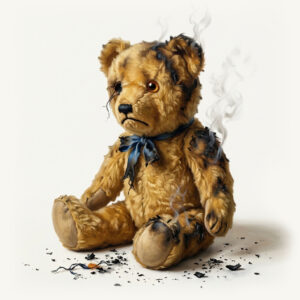
My Father's Other Children
There was a knock at the door.
My sister had just emptied the thirteenth open jar of stale nuts.
This detail matters because nothing prepares a person to receive cremated surrogate siblings quite like discovering that two adults required thirteen simultaneous nut-storage options.
The neighbor stood outside with a vintage wicker flower basket hanging from her left elbow. In one hand she held an urn shaped like a black iron robin. In the other, she carried a medium-sized glass pickle jar filled with black soot.
“Hi,” she said. “I saw your car and thought I’d bring the kids and Robin back.”
My sister choked and chuckled at the same time.
It is a useful family reflex. The body attempts horror and laughter simultaneously, then leaves the throat to negotiate jurisdiction.
“Oh,” she managed. “Come in.”
The neighbor entered carrying the household in its final form: the wife as a decorative bird, the children in recycled food storage.
She explained again how insistent my father had been about cremating the stuffed animals.
“He really didn’t want anybody to find them.”
My sister kept staring at the pickle jar.
The children had been found.
The children had been cremated.
The children had been returned.
The neighbor thought my sister might want to scatter everyone together.
My sister declined.
She explained that her brothers had visited and that they had already held a small ceremony. It had been, she said, very fitting.
This was true, although “ceremony” was doing some generous administrative work.
“You can take the ashes,” she told the neighbor. “Really. I’ll keep Robin and offer to send her to her nephew in California.”
Then my sister told her what I had noticed in the photographs.
There were four stuffed animals and four biological children. The sizes and apparent genders aligned. A lamb, a bear, a monkey, and a bird. The animals had been posed, dressed, transported, celebrated, and photographed in the ordinary situations through which parents build a record of family life.
They were us.
The neighbor squealed and nearly dropped the jar.
This was the correct response.
My sister gave her the abbreviated history: the four real children, the abandonment, the long distances between biology and fatherhood. Enough information to change the weight of the object in her hands.
The neighbor began to cry.
Her own father had died only a few weeks before my father entered hospice. She missed him terribly.
“I don’t know what I would have done without my father growing up,” she said.
There are sentences so innocent they become violent only after entering the wrong room.
My sister hugged her.
She comforted the grieving woman who stood in her father’s house holding the cremated remains of the toy children he had cared enough to provide for.
She also rolled her eyes.
She was not proud of this. The woman had done nothing wrong. She had lost a father she loved and was trying to imagine childhood without him.
My sister did not have to imagine it.
Still, she held her. This is another family reflex: caring for the person whose grief has accidentally insulted yours.
The neighbor agreed to take the children back.
My sister told her to take the wicker basket too. That was where they had lived.
Before the neighbor left, my sister offered her a nativity set that held some meaning for her. The neighbor accepted it. They exchanged thank-yous and see-you-laters, and then she walked away carrying a small religious family and a pickle jar containing the remains of another one.
The stuffed animals had acquired a new name by then.
The Ashkids.
Their father was dead. His wife was dead. The children had been burned according to his wishes, delivered to his biological daughter, declined, and returned to the neighbor in the basket that had once been their home.
Even after cremation, they had better continuity of care than we did.
I still wonder what the neighbor thought when she originally received the request.
A dying man had asked her to enter his home, locate four specific stuffed animals, and make certain no one else ever saw them. Perhaps he offered an explanation. Perhaps she decided, correctly, that there are moments when neighborliness requires a person not to ask follow-up questions.
She kept her promise.
There is something touching about that, which is irritating.
There is also something sad about the fact that I never saw the animals themselves.
I would have liked to inspect them.
Not out of sentiment. Not entirely.
I wanted to check the seams.
I wanted to see whether anything had been sewn inside them. Family jewels. Money. Letters. A secret map. A confession written in blood on lambskin parchment. Anything that might justify the elaborate finality of cremation.
I doubt there was.
The secret was probably the animals themselves.
Perhaps my father understood, at the end, what they would look like to the people he had left behind. Perhaps he feared the parallels would be obvious. Perhaps he knew that four toys, arranged as children and given the rituals of children, might function as an accusation once the actual children entered the room.
Or perhaps he simply loved them.
That possibility may be the strangest one.
He may have loved them sincerely, in whatever way a person loves an object onto which he has projected enough life. He may have felt tenderness toward them. Responsibility. Loyalty. He may have believed they had shared experiences worth protecting.
People are capable of genuine emotion inside arrangements that appear grotesque from the outside.
That does not make the emotion false.
It also does not make the arrangement harmless.
I do not resent a stuffed bird.
That would be beneath me, though not by as much as I would prefer.
The bird did not take anything from me. Neither did the lamb, the bear, or the monkey. They did not choose their assignments. They were soft objects recruited into a psychological drama without informed consent.
Still, it is difficult not to notice the division of labor.
The real children carried the consequences.
The stuffed children received the rituals.
They were taken on trips. They were tucked into beds. Their Christmases were photographed. Their affection was accepted. Their Father’s Day card was preserved inside a book.
And when death approached, arrangements were made for them.
He had worried about what would happen to his other children after he was gone.
That may be the closest he ever came to planning for us.

Ryan Villiers
Ryan Villiers is a Los Angeles-based writer and creative director whose work explores family, inheritance, memory, and the absurd ways people survive one another. He is currently seeking publication for his debut novel, The Field of Furze.